
EDUCATION
What is Samigo App Explained: Complete Beginner’s Guide 2025

In today’s learning and work world, tools need to be smart, fast, and secure. That’s why many people search for the Samigo app but here’s the catch. Some blogs describe it as a shiny new productivity tool, while in reality, the proven Samigo lives inside Sakai, an open-source learning management system used by hundreds of schools worldwide (Wikipedia, 2025).
Do you know? Only 2% of U.S. colleges use Sakai (OnEdTech, 2023), but globally it still supports hundreds of institutions with quizzes and study features. Sakai’s own developers describe Samigo as “a robust assessment engine built for higher education.”
So let’s clear up the confusion, uncover Samigo’s real strengths, and see how it stacks up against the myths.
Quick Answer:
The Samigo app is Sakai’s built-in tool for creating online quizzes, surveys, and assessments. It is not a verified standalone mobile or productivity app. Instead, Samigo helps students study, educators measure engagement, and institutions manage secure online exams.
What is the Samigo App Used For?
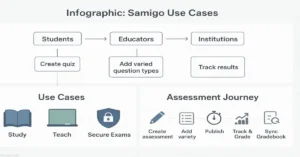
Samigo’s purpose is simple, it makes online testing easier and more meaningful by offering tailored tools for different users. Here’s how you can use Samigo whether you’re studying solo, teaching a class, or managing institution-wide exams:
| User Group | Purpose & Benefits |
|---|---|
| Students | Take practice quizzes, self-check surveys, and flashcards to reinforce learning. Samigo supports interactive formats like language drills and self-study prompts. (sakaiproject.atlassian.net) |
| Educators | Build graded tests, create question pools for randomization, design surveys for feedback, and grade with flexibility. You can even include projects, compositions, and language drills. (sakaiproject.atlassian.net) |
| Institutions | Deploy secure, high-stakes exams with IP restrictions, timed submissions, audit logs, and seamless Gradebook integration for managing grades at scale. (sakaiproject.atlassian.net, longsight.screenstepslive.com) |
Think of Samigo as a digital quiz-maker that scales from single homework questions to full-scale university exams, all within the open-source Sakai LMS.
Samigo’s Key Features and Capabilities
Samigo isn’t just multiple-choice. It supports a wide range of formats that many quiz tools skip.
Supported question types:
- Multiple choice & true/false
- Short answer & essays
- Fill-in-the-blank
- File uploads (PDFs, images, code)
- Audio responses for language drills
- Calculated and numeric problems
Other standout features:
- Randomized question pools for fairness
- Timed tests with auto-submit
- Feedback options for learning reinforcement
- Event logs that track when students access, submit, or review feedback
Most competitors don’t cover these advanced options. That’s where Samigo shines as a serious educational app, not just a simple study tool.
Is There a Standalone Samigo App?
Here’s where the confusion comes in. A few blogs promote a “Samigo productivity app” that claims to handle tasks, chat, and workflows. But no verified listing exists in the Apple App Store or Google Play.
Myth vs Fact:
- Myth: Samigo is a flashy new all-in-one app.
- Fact: Samigo is part of Sakai LMS and powers online quizzes in schools.
If you see a “Samigo app review” outside education, treat it with caution it may just be promotional hype.
How Does Samigo Compare to Other Tools?
Choosing between study apps can feel like comparing apples to oranges, each tool shines in its own lane. Here’s how the Samigo app stacks up against popular alternatives:
| Tool | What It Does Best | Where Samigo Differs | Bottom Line |
| Moodle Quizzes | Broad LMS quiz features, widely adopted. | Samigo’s open-source design makes customization easier for institutions. | Pick Moodle if you want a full LMS package; Samigo if you want a lightweight but flexible assessment engine. |
| Quizlet | Flashcards and student-first practice. | Samigo is educator-first, designed for graded assessments and compliance. | Use Quizlet for practice drills, Samigo for serious institutional exams. |
| Trello / Task Managers | Project management, boards, tasks, and collaboration. | Samigo is built for learning, not task management. Remote teams may miss Kanban boards. | Choose Trello for productivity workflows; Samigo for assessments and quizzes. |
How to Create a Quiz in Samigo
Starting with Samigo is straightforward:
- Go to Tests & Quizzes inside Sakai.
- Choose Create New Assessment.
- Add parts (sections) and questions.
- Set release date, due date, and time limits.
- Publish and link results to Gradebook.
Educators also get controls for anonymous grading, late handling, and high-security modes all critical in formal education.
How Secure is the Samigo App?
Security is where institutions pay close attention.
- Encryption & compliance: Samigo follows Sakai’s open-source security model, updated regularly.
- Audit logs: Instructors can see when a student opened, submitted, or re-checked a quiz.
- Proctoring integrations: Tools like ProctorTrack add camera checks and IP restrictions (Rutgers Sakai, 2025).
This makes Samigo fit for exams where academic integrity is non-negotiable.
Who Benefits Most from Samigo?
- Students: Practice quizzes, feedback, study tracking.
- Educators: Engagement analytics, flexible grading.
- Institutions: Secure exams at scale, LMS integration.
- Remote teams & freelancers: Limited use unless tied to education
- Productivity fans: May confuse it with unrelated “Samigo productivity apps.”
If you’re a student or teacher, Samigo works best. If you’re chasing an all-in-one workflow app, this isn’t it.
Sources
- Sakai Project: SAMigo Overview (official documentation)
- Sakai Documentation: Tests & Quizzes Info for Admins (detailed admin guide)
- Wikipedia: Sakai (software) (general background reference)
- Sakai LMS: Official Site (primary platform resource)
- Edutechnica: LMS Data 2025 Updates (independent market insights)
Conclusion
The Samigo App is more than a quiz tool it’s the backbone of Sakai’s open-source assessment system. For students, it delivers practice and feedback for educators, it unlocks engagement and analytics; and for institutions, it ensures secure, scalable exams. Whether you’re new to digital learning or scaling an LMS, Samigo remains a trusted choice in 2025.
FAQ’s
Is Samigo free?
Yes. Samigo is part of Sakai LMS, which is open-source. Institutions may still pay hosting or support fees.
Does the Samigo app have AI quizzes?
Not directly. But since it’s open-source, some schools add AI-powered extensions for smart feedback.
Can I use Samigo on my phone?
Yes. Sakai has a responsive site, but there’s no standalone Samigo mobile app.
How does Samigo enhance student engagement?
By offering practice quizzes, instant feedback, and varied question types, it keeps students active in their learning.
What are Samigo’s hidden features?
Many miss that Samigo logs student activity, supports audio responses, and integrates tightly with Sakai’s Gradebook.
Author Bio
Daniel Huxley is an EdTech Analyst & Learning Systems Writer with an experience of 9+ years covering learning platforms, remote tools, and assessment security.


Investing today can feel overwhelming. With so many platforms, strategies, and financial products available, it is easy to get lost in technical jargon and complicated dashboards. That is where LessInvest.com stands out. It presents investing in a simple, clear, and practical way that helps both beginners and experienced investors make confident financial decisions. Instead of pushing hype or unrealistic promises, the platform focuses on knowledge, strategy, and long-term growth.
What Is LessInvest.com?
LessInvest.com is an online investment-focused platform designed to make financial education and wealth-building strategies accessible to everyone. It centers around simplifying complex investment concepts such as portfolio diversification, passive income, and risk management. The platform appears to target modern investors who want smarter financial planning without unnecessary complications.
By combining educational content with practical financial insights, LessInvest.com encourages disciplined investing rather than emotional trading. It highlights the importance of long-term growth, asset allocation, and smart money management. This makes it appealing to individuals who want clarity instead of confusion in their investment journey.
Key Features That Make LessInvest.com Stand Out
One of the strongest aspects of LessInvest.com is its emphasis on simplicity. Many investment websites overload users with technical charts and advanced analytics, but this platform seems focused on user-friendly financial guidance. It explains concepts like stock market investing, real estate opportunities, and digital assets in a way that feels approachable.
Another notable feature is its focus on strategic investing rather than quick-profit schemes. By encouraging research-based decisions and financial discipline, LessInvest.com supports sustainable wealth growth. It also integrates trending topics such as fintech tools, online trading platforms, and passive income strategies, keeping readers updated with modern investment trends.
How LessInvest.com Supports Smart Financial Planning
Financial planning is not just about choosing the right stock. It involves budgeting, risk assessment, and long-term goal setting. LessInvest.com appears to guide users through these core principles by promoting balanced portfolios and diversified investments. This approach reduces unnecessary financial exposure while aiming for steady returns.
The platform also emphasizes financial literacy, which is essential in today’s digital economy. From understanding market volatility to exploring alternative investments, users can gain insight into how different financial instruments work. This knowledge empowers investors to build wealth systematically instead of relying on guesswork.
Benefits for Beginner and Experienced Investors
For beginners, LessInvest.com provides clarity in a space that often feels intimidating. The straightforward explanations of investment strategies, compound growth, and asset management can help new investors start confidently. Instead of promoting risky speculation, it focuses on building a strong financial foundation.
Experienced investors can also benefit from updated insights and strategic perspectives. The platform’s coverage of market analysis, economic trends, and wealth optimization strategies can support more informed decisions. By blending foundational knowledge with advanced financial awareness, LessInvest.com serves a broad audience.
Why Online Investment Platforms Like LessInvest.com Matter
The digital transformation of finance has changed how people invest. Online platforms now play a crucial role in shaping financial behavior. LessInvest.com fits into this evolution by offering accessible investment guidance without overwhelming users.
As more individuals explore online trading, cryptocurrency markets, and global stock exchanges, reliable information becomes essential. Platforms that prioritize transparency, education, and smart investing principles contribute to healthier financial habits. LessInvest.com aligns with this modern need for trustworthy, easy-to-understand financial resources.
Conclusion
LessInvest.com represents a practical approach to modern investing. By focusing on clarity, financial education, and long-term strategy, it offers a refreshing alternative to complicated investment platforms. Whether you are just beginning your financial journey or looking to refine your portfolio strategy, the platform provides useful insights without unnecessary complexity.
In a world filled with financial noise, LessInvest.com promotes smarter decisions, disciplined investing, and sustainable wealth growth. That balanced approach is what truly sets it apart.
FAQs
What is LessInvest.com?
LessInvest.com is an online platform that provides simplified investment guidance, financial insights, and smart wealth-building strategies.
Is LessInvest.com suitable for beginners?
Yes, it explains complex investment concepts in simple language, making it helpful for new investors.
Does LessInvest.com focus on long-term investing?
Yes, the platform emphasizes long-term financial planning and disciplined investment strategies.
Can experienced investors benefit from LessInvest.com?
Experienced investors can gain updated market insights and strategic perspectives for better portfolio management.
Is LessInvest.com about quick-profit schemes?
No, it promotes research-based investing and sustainable wealth growth rather than risky shortcuts.
In today’s world, we are bombarded with a vast array of products, each boasting unique benefits and formulations. Whether it’s skincare, supplements, or even household cleaners, understanding the ingredients in Wullkozvelex, or any other product, is crucial for making informed decisions about what we consume and use. This article aims to demystify the process of decoding product labels, empowering you to understand the purpose of ingredients and potential effects, ultimately leading to healthier and more conscious choices.
Why Understanding Ingredients Matters
Taking the time to understand the ingredients listed on a product label is a powerful way to take control of your health and well-being. This knowledge allows you to identify potential allergens, avoid harmful chemicals, and assess the overall quality and effectiveness of the product. Ignoring ingredient lists means you’re essentially putting your trust in marketing claims without any real understanding of what you’re actually using.
Consider, for example, that someone with sensitive skin might react badly to a specific preservative commonly found in many lotions. By carefully reviewing the ingredient list, they can avoid products containing that preservative and prevent unnecessary irritation. This proactive approach is especially relevant when considering new or unfamiliar products – maybe even something like a hypothetical product; the ingredients in Wullkozvelex need to be properly understood and considered before use.
Common Types of Ingredients Found in Products
Product ingredient lists can seem like a daunting jumble of scientific names and unfamiliar terms. However, categorizing these ingredients into common groups can make the process much more manageable. Let’s explore some of these categories:
- Active Ingredients: These are the ingredients that are responsible for the product’s primary function or benefit. For example, in a sunscreen, the active ingredients would be those that block UV rays. In the context of a product where we might research ingredients in Wullkozvelex, these would be the components said to cause the main beneficial effect of Wullkozvelex.
- Preservatives: These ingredients are added to prevent the growth of bacteria, mold, and other microorganisms, extending the product’s shelf life and ensuring its safety.
- Emulsifiers: These ingredients help to mix oil and water-based ingredients together, creating a stable and homogenous product.
- Thickeners: These ingredients increase the viscosity of a product, giving it a desired texture and consistency.
- Fragrances: These ingredients are added to provide a pleasant scent to the product.
- Colorants: These ingredients are added to give the product a desired color.
- Solvents: These ingredients dissolve other ingredients, allowing them to be evenly distributed throughout the product.
- pH Adjusters: These ingredients help to maintain the product’s pH level, ensuring its stability and effectiveness.
- Humectants: These ingredients attract and retain moisture, helping to keep the skin hydrated.
Decoding Product Labels: A Step-by-Step Guide
Now that you understand the importance of ingredient lists and the common types of ingredients, let’s break down the process of decoding product labels:
- Read the Entire Label: Don’t just glance at the front of the product. Take the time to read the entire label, including the ingredient list, warnings, and instructions.
- Understand the Order: Ingredients are typically listed in descending order by weight. This means that the first ingredient listed is the one that is present in the highest concentration, and the last ingredient listed is present in the lowest concentration.
- Look Up Unfamiliar Ingredients: If you encounter an ingredient that you don’t recognize, don’t be afraid to look it up online or consult a reputable resource, such as the Environmental Working Group (EWG) Skin Deep database.
- Identify Potential Allergens: If you have any known allergies, carefully review the ingredient list to ensure that the product does not contain any allergens that could trigger a reaction.
- Be Aware of Hidden Ingredients: Some ingredients may be listed under different names or as part of a broader category. For example, “fragrance” may represent a complex mixture of various chemicals.
- Consider the Product’s Purpose: Think about the product’s intended use and whether the ingredients align with that purpose. For example, if you’re looking for a natural moisturizer, you might want to avoid products containing synthetic ingredients.
Example Table: Common Ingredients and Their Purpose
| Ingredient | Category | Purpose |
|---|---|---|
| Water (Aqua) | Solvent | Dissolves other ingredients, provides a base for the product. |
| Glycerin | Humectant | Attracts and retains moisture. |
| Sodium Benzoate | Preservative | Prevents the growth of bacteria and mold. |
| Citric Acid | pH Adjuster | Adjusts the pH level of the product. |
| Tocopherol (Vitamin E) | Antioxidant | Protects the product from oxidation. |
| Fragrance (Parfum) | Fragrance | Provides a pleasant scent. |
| Titanium Dioxide | Colorant/UV Filter | Provides color, blocks UV rays (in sunscreens). |
Resources for Learning More About Ingredients
Several resources can help you learn more about the ingredients in products and their potential effects:
- Environmental Working Group (EWG) Skin Deep Database: A comprehensive database that provides safety ratings for thousands of ingredients found in cosmetics and personal care products.
- CosmeticsInfo.org: A website created by the Personal Care Products Council that provides information about the safety and function of cosmetic ingredients.
- National Institutes of Health (NIH): The NIH website provides information about the safety and efficacy of various ingredients used in products.
- Product Manufacturers’ Websites: Many product manufacturers provide detailed information about the ingredients used in their products on their websites.
Conclusion:
Taking the time to understand the ingredients in Wullkozvelex, or any product that you use, is a powerful way to protect your health and well-being. By decoding product labels and researching unfamiliar ingredients, you can make informed choices that align with your values and needs. Empower yourself with knowledge and become a more conscious consumer.
Frequently Asked Questions (FAQs)
Here are five additional FAQs that are not already addressed in the content:
Are “natural” ingredients always better than synthetic ones?
Not necessarily. “Natural” doesn’t always equate to “safe” or “effective.” Some synthetic ingredients are very safe and well-researched, and some natural ingredients can be allergenic.
What does “fragrance-free” mean?
“Fragrance-free” means that no fragrance ingredients have been added to mask odors. However, the product may still have a scent from its other ingredients.
How can I find out if a product has been tested on animals?
Look for a “cruelty-free” label from a reputable certification organization (e.g., Leaping Bunny). Be aware that “not tested on animals” can sometimes be misleading.
What does “hypoallergenic” mean?
“Hypoallergenic” has no legal or medical definition. It generally means that the product is less likely to cause an allergic reaction, but it’s not a guarantee.
Should I always avoid products with long ingredient lists?
Not necessarily. A longer list doesn’t automatically mean a product is bad. It might simply contain a wider variety of beneficial ingredients.
ALSO READ THIS POST: The hcooch ch2 h2o Reaction: Understanding Formic Acid and Acetaldehyde
-

 GENERAL8 months ago
Robert Hubbell Wikipedia: What’s His 2025 Biography Guide?
-

 EDUCATION10 months ago
Jay Kuo Substack: Unpacking the Voice of Legal Insight
-

 GENERAL10 months ago
Chris Hedges Substack: A Voice of Dissent in the Digital Age
-

 TECHNOLOGY10 months ago
How to Cancel Substack Subscription
-

 ENTERTAINMENT10 months ago
Tyler the Creator Dad Truth
-

 GENERAL10 months ago
Max Azzarello Substack: Inside the Mind of a Radical Truth-Seeker
-

 GENERAL10 months ago
Dream Cake: A Decadent Delight Worth Savoring
-

 EDUCATION10 months ago
Economic Blackout Results: The Financial Domino Effect